• Home
  • Primary
  • Secondary
  • Students
  • Library
  • About us
  • Contact us
  • SAPS Associates login

Search the site

 
  • Teaching Resources
  • Beyond the Classroom
  • Plant Science News
  • Specifications
  • CPD

Filter secondary resources by...

Key Stage
4-7 (KS1)
7 -11 (KS2)
11 -14 (KS3)
14 -16 (KS4)
Post 16
Topic
Adaptation
Agriculture & farming
Biochemistry
Climate change
Ecology & evolution
Fertilisation & cell cycle
Genetics
GM & Selective breeding
Movement in & out of cells
Nutrient cycles
Photosynthesis
Plant cells & tissues
Plant growth
Plant nutrition
Plant responses & hormones
Products of plants
Respiration in plants
Transport in plants
Home > Secondary > Teaching Resources
SAPS
Photosynthesis using algae wrapped in jelly balls Photosynthesis using algae wrapped in jelly balls

This lively practical uses algae to look at the rate of photosynthesis. The algae are 'immobilised' in sodium alginate, and then used for the experiment.

Measuring the rate of photosynthesis Measuring the rate of photosynthesis

A brief outline of various ways to measure the rate of photosynthesis.

Ecology Exercise 1 - Measuring abundance and random sampling Ecology Exercise 1 - Measuring abundance and random sampling

A simple simulation, giving students an opportunity to practice random sampling to measure the abundance of various different species on an area of grassland, before they carry out practical fieldwork.

Effect of light colour & intensity on the rate of photosynthesis Effect of light colour & intensity on the rate of photosynthesis

This information is to support post-16 experiments using the immobilised algal system.

Student Sheet 4 - Pollen Tube Growth Student Sheet 4 - Pollen Tube Growth

The growth of pollen tubes is easily observed under medium power of a microscope, and this practical suggests some ways in which this can be done.

Plants in the Science Curriculum Plants in the Science Curriculum

This resource supports you in teaching current plant science requirements for 14-16 and post-16 classes, covering accessible, low-budget plant material and their associated teaching topics. Plants are linked with their teaching topics and coded to exam board requirements to help teachers and technicians plan investigations that enable students to engage with biology.

Ecology Exercise 2 - The distribution of species across a footpath Ecology Exercise 2 - The distribution of species across a footpath

A simple simulation, giving students an opportunity to practice using systematic sampling to investigate changes in species richness across a footpath, before they carry out practical fieldwork.

Student Sheet 10 - Thin layer chromatography for plant pigments Student Sheet 10 - Thin layer chromatography for plant pigments

Several different pigments are involved in the absorption of light. This experiment shows how these pigments can be extracted from plants and then separated.

Tissue Culture - cloning cauliflowers Tissue Culture - cloning cauliflowers

Unlike animal cells, many plant cells are totipotent, meaning that each cell has the capacity to regenerate the entire plant. Plants can be regenerated from leaves, stems, roots, meristems, flowers and even pollen or ovules. These worksheets explain how to take explants from cauliflowers and root them.

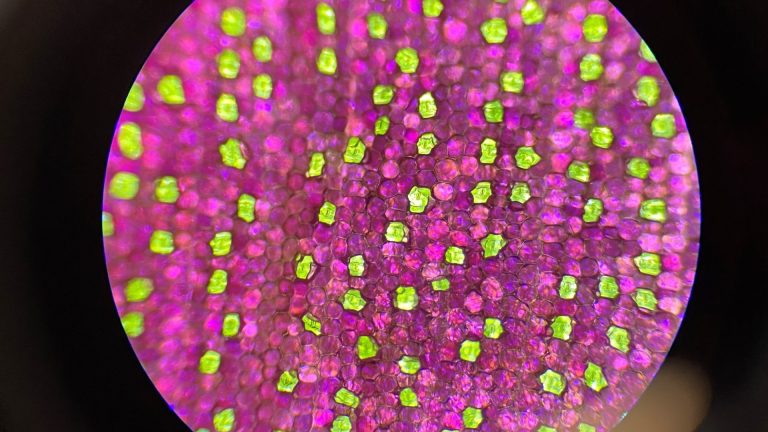
Measuring Stomatal Density Measuring Stomatal Density

Estimation of stomatal density is often done when studying photosynthesis (at GCSE and higher levels), and can offer a way of illustrating use of the graticule with post-16 students. There are a number of ways to measure stomatal density, and some are outlined here.

Student Sheet 5 - Investigating Seed Germination Student Sheet 5 - Investigating Seed Germination

A simple way to investigate the germination of seeds.

Tissue Culture and Micropropagation  - Cloning Cauliflowers Tissue Culture and Micropropagation - Cloning Cauliflowers

An updated set of technical instructions and an illustrated student sheet, which aim to clarify some of the difficulties people have been having with cloning cauliflowers at GCSE.

Photosynthesis - A Survival Guide Photosynthesis - A Survival Guide

A collection of powerpoints and activities, encouraging teachers to take a new and refreshing look at photosynthesis.

Student Sheet 8 - The response of seedlings to light Student Sheet 8 - The response of seedlings to light

Seedlings growing on a windowsill will often bend towards the window. The simple technique described on this worksheet will help students design an nvestigation to find out more about this tropic response.

Demonstrating oxygen evolution during photosynthesis using Cabomba Demonstrating oxygen evolution during photosynthesis using Cabomba

Demonstrating oxygen formation during photosynthesis can be a tricky process. One common way is to gather bubbles of gas given off by an aquatic plant. This technical guide introduces Cabomba, a reliable plant which is much more effective than the traditional Elodea.

The inhibition of catechol oxidase by lead The inhibition of catechol oxidase by lead

The enzyme, catechol oxidase, is easily extracted from banana. In this practical, students measure the extent to which lead inhibits the catechol oxidase.

Fruit Juice Production & Enzyme Recovery Fruit Juice Production & Enzyme Recovery

Fruit juice companies use a variety of different treatments and enzymes to maximise their yield. In this experiment students investigate the effectiveness of these different enzymes.

Student Sheet 12 - Plant Tissue Culture with Seedlings Student Sheet 12 - Plant Tissue Culture with Seedlings

These techniques introduce students to plant tissue culture

Measuring changes in ascorbic acid (vitamin C) concentration in ripening fruit and vegetables Measuring changes in ascorbic acid (vitamin C) concentration...

A way to measure the amount of ascorbic acid (vitamin C) in fruits and plant material.

Student Sheet 13 - Plant Tissue Culture Part 2: The effect of sugar on the growth of root explants Student Sheet 13 - Plant Tissue Culture Part 2: The effect of...

Students examine the growth of root explants over a 7 day period, in a follow up to Student Sheet 12. This is more demanding than the protocol outlined in Student Sheet 12 and is more suitable for year 12-13 students.

 
<< Start < Prev 1 2 3 4 5 6 7 8 Next > End >>
Page 1 of 8
Joomla SEO powered by JoomSEF
 
 
  • RSS
  • Follow Us
Primary
  • Teaching Resources
  • Beyond the Classroom
  • Hints & Tips
Students
  • Projects
  • Further Reading
  • Careers
  • Further Study
Secondary
  • Teaching Resources
  • Beyond the Classroom
  • Plant Science News
  • Specifications
Library
  • Plant Science Image Library
  • Pollen Image Library
  • Identifying Trees & Shrubs
Legal & Other
  • Terms & Conditions
  • Health and Safety
  • Accessibillity

© 2012 Science & Plants for Schools