• Home
  • Primary
  • Secondary
  • Students
  • Library
  • About us
  • Contact us
  • SAPS Associates login

Search the site

 
  • Teaching Resources
  • Beyond the Classroom
  • Plant Science News
  • Specifications
  • CPD

Download Resources

There are currently no resources associated with this article - perhaps you could suggest one

More like this

  • Investigating mitosis in allium root tip squash
Home > Secondary > Teaching Resources > Floating garlic - growing roots

Floating garlic - growing roots

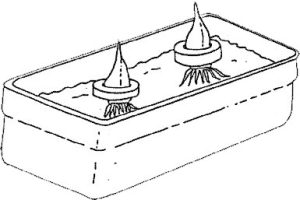
Here is a simple way of growing garlic roots for the root tip squash practical - a modification of the method using polystyrene ceiling tiles.

Pipe insulation with an internal diameter of approximately 15 mm is readily obtainable from a range of DIY stores. It is easily cut with scissors or a knife and we find that lengths of 1.5 to 2 cm are suitable. Cloves of varying diameters can sit in these rings of foam and if the cloves are very small, two can be placed side by side.

There is something very satisfying seeing garlic cloves with their very own lifebelts bobbing about on a tray of water.

1. Use pipe insulation with an approx internal diameter of 18 mm

Slice into sections measuring approx 15 mm in depth

2. Separate garlic bulb into cloves and insert one (or two small) into each ring.

3. Float rings on water in a suitable tray. Ice-cream containers are ideal. Snip off root tips as required after 3 to 4 days.


Mrs Alouisa Dawkins
(Bancroft's School, Woodford Green, Essex)

Tags: 11 -14 (KS3) 14 -16 (KS4) Post 16 Fertilisation & cell cycle Plant growth
 
Joomla SEO powered by JoomSEF
 
 
  • RSS
  • Follow Us
Primary
  • Teaching Resources
  • Beyond the Classroom
  • Hints & Tips
Students
  • Projects
  • Further Reading
  • Careers
  • Further Study
Secondary
  • Teaching Resources
  • Beyond the Classroom
  • Plant Science News
  • Specifications
Library
  • Plant Science Image Library
  • Pollen Image Library
  • Identifying Trees & Shrubs
Legal & Other
  • Terms & Conditions
  • Health and Safety
  • Accessibillity

© 2012 Science & Plants for Schools